Latest news··app.siftserve.com
Your site, read as a buyer's journey
Every category in the content audit now reads as a buyer's journey: which pages carry each stage, which buyer questions they answer, and the gaps to brief or test next.
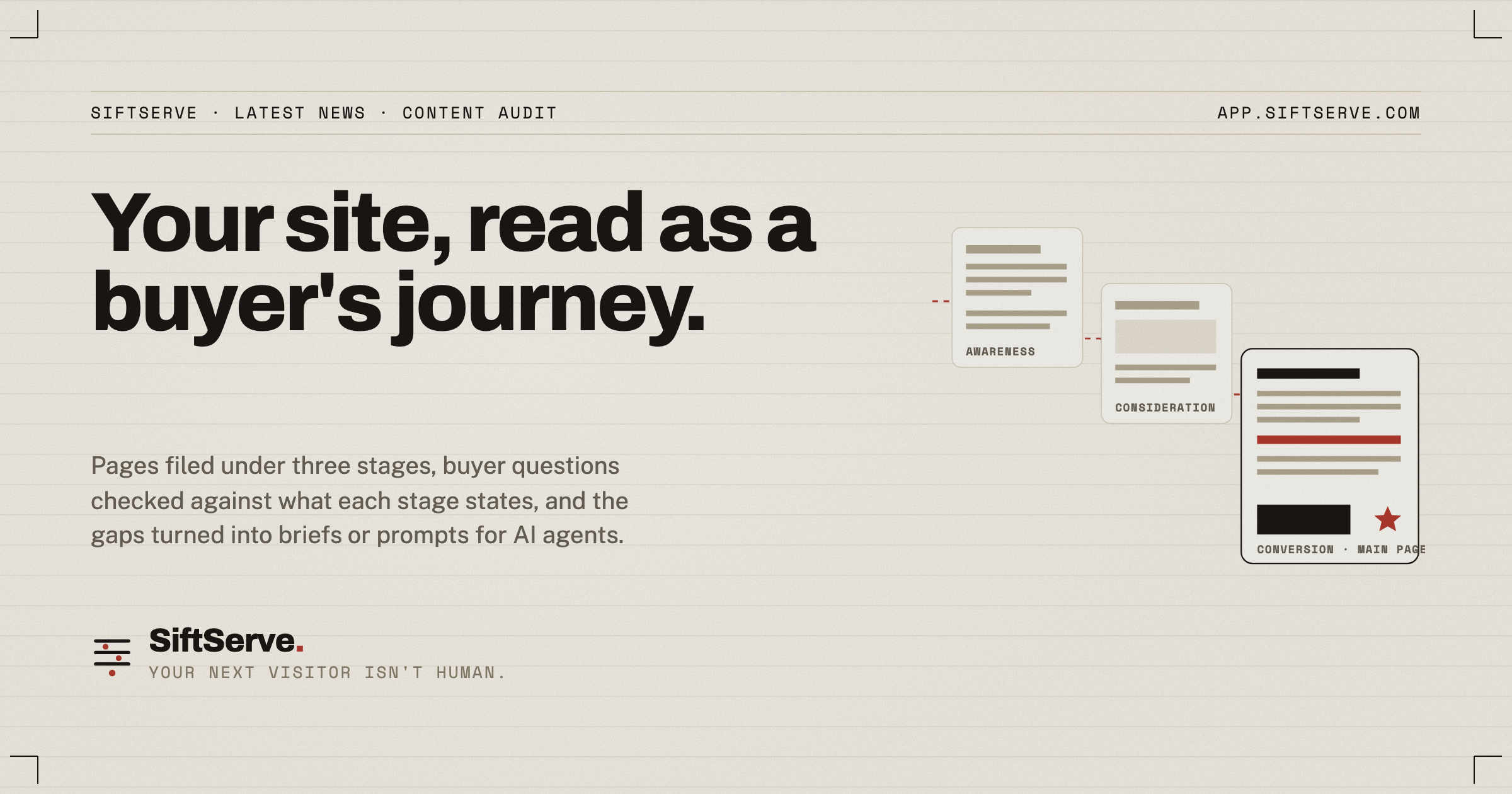
Open a category in the content audit on app.siftserve.com and it now reads as a buyer's journey. The pages that carry the category sit under three stages, one of them is marked as the page you want AI agents to cite when the buyer is ready to act, and the category gets a completeness score: the share of buyer questions those pages answer. The questions they don't answer become briefs or test prompts in one click.
What a category is now
A category is anything the audit derives from your own site: an offering, a use case, an industry you serve, a location, a plan, a certification. Until now it held facts. Now it also holds the pages a buyer moves through on the way to you.
Awareness pages name the problem, not the product: guides, posts, glossaries. Consideration pages prove you're the right choice: the product or service page, the about page, comparisons, case studies. Conversion pages remove the last friction: the page with the call to action and the policies it leans on. The audit files every page that states or names the category under one of those, proposes the main page to be cited, and leaves the final call to you. Move a page, star a different one, add a URL the audit didn't tie to the category. Your choices survive every rerun.
Buyer questions, checked against what you state
Each category keeps a bank of questions in the buyer's words, per stage. "Is this worth it" at awareness. "How does it compare" at consideration. "What happens after I order" at conversion. The audit seeds the bank from its own judgement of what the category could be cited for, a generator drafts more on request (each draft is checked before you see it), and you can type one in.
Every active question is judged against the verified facts on that stage's pages and comes back answered, partial, or missing. Completeness is the result: answered questions count in full, partial ones for half, averaged across the stages that have questions. A category with no main page to be cited caps at 70, because a category with no page to send the buyer to can't be complete.
Gaps you can act on
The missing and partial questions are clustered into gaps, each with the page type that would close it. Two buttons sit on every gap. Write brief turns it into an outline: the questions to answer, the facts to state, where the page belongs. Add to prompts pushes its questions into your GEO prompts, tagged with the category and stage, so the next GEO audit measures whether AI engines answer them from you.
Under the stages, a chart shows citations and crawls per page over the window you pick, and says plainly when the main page to be cited wasn't cited at all.
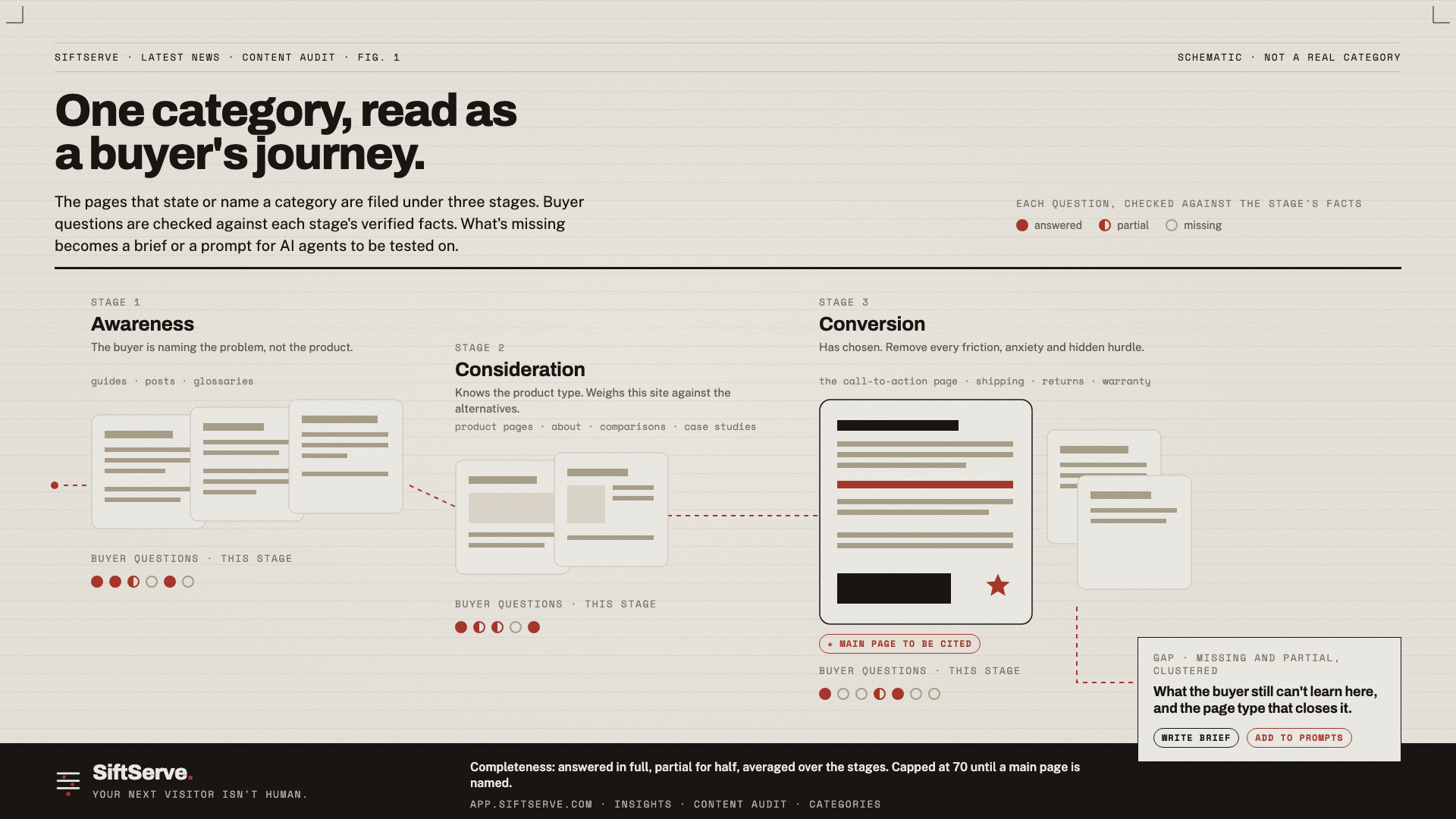
One category, read as a journey. Pages under three stages, one starred as the main page to be cited; buyer questions per stage marked answered, partial or missing; the gaps feed a brief or the GEO prompts. Schematic, not a real category.
Why now
A buyer who asks an AI engine arrives decided. The engine did the comparison. Conductor's 2026 benchmarks put conversion from AI-referred visitors at 4.4× that of organic search (Conductor, industry numbers, not ours). And what gets a page into that answer is measurable: the Princeton GEO study found 30–40% more AI visibility from added structure, statistics and citations (Aggarwal et al., KDD 2024). So the question for every category on your site is which buyer questions your pages answer at each stage, and completeness puts that number on the page.
What to do next
Run the content audit on your domain, or re-run it, and open Categories. Sort by least complete first. For your top offerings, confirm the main page to be cited. Generate questions for the stage with the fewest. Brief the biggest gap, or push it into the prompts and let the next GEO audit tell you whether it closed. Reject the categories that aren't a thing on your site, and add the ones the audit missed; the sifted homepage lists your offerings, use cases, industries and locations and links each one to its page.
- content audit
- categories
- buyer journey
- GEO prompts