Latest news··app.siftserve.com
GPT-6 and Claude Sonnet 5 cut the model cost of a sifted page by 32%
Anthropic and OpenAI shipped new models on the same day. Two days later they're the defaults behind every sift, and the model cost of a sifted page is down 32%.
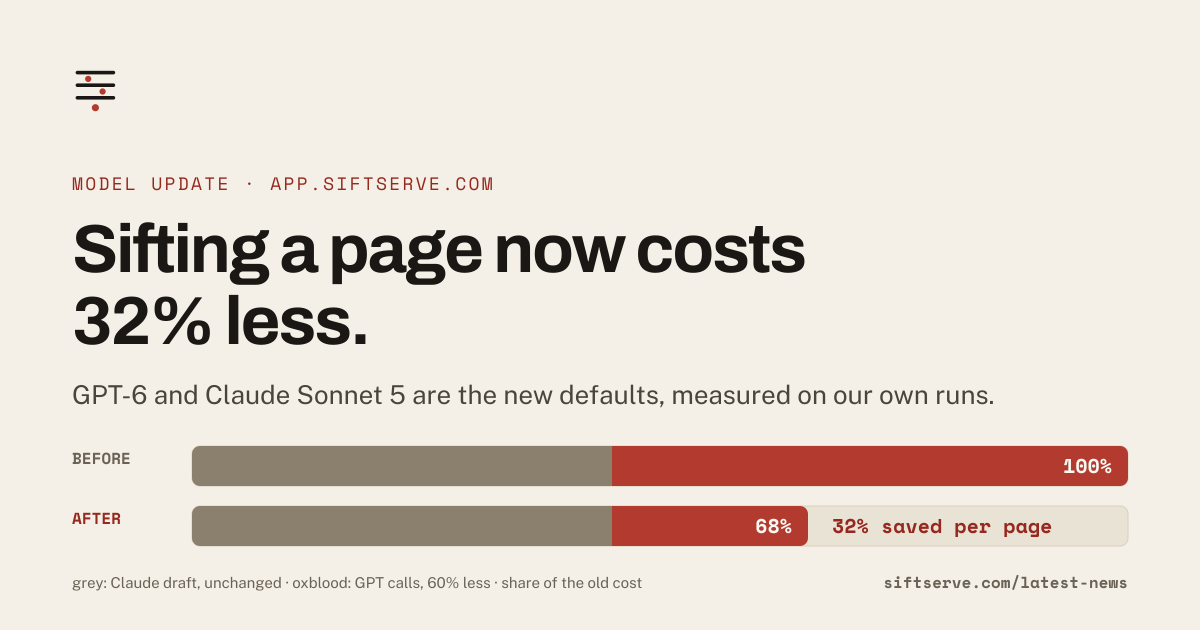
On 2026-09-22 the two labs we build on shipped within hours of each other. Anthropic released Claude Opus 5.5, and OpenAI released GPT-6 Sol and GPT-6 Luna. By 2026-09-24 every model call behind app.siftserve.com runs on the new generation, and the model cost of one sifted page is down 32%.
Two launches, one theme
Both announcements led with price.
OpenAI credits improvements in caching and inference for letting it cut API prices for Sol and Luna by 50% against GPT-5.6's promotional pricing. Against the list prices we'd been paying, the drop was steeper: GPT-6 Sol is 60% cheaper on input and 67% cheaper on output than GPT-5.6 Sol, and GPT-6 Luna is 90% and 92% cheaper than GPT-5.6 Luna (OpenAI API pricing page, read 2026-09-24).
Anthropic's post says Opus 5.5 costs 40% less to run than Opus 5 on typical workloads: list prices 20% lower, cache reads 60% lower. And the model we draft with, Claude Sonnet 5, had its own price story earlier this summer. It launched on 2026-06-30 at an introductory rate that was due to rise in September, and Anthropic made that rate permanent instead (Anthropic pricing page, read 2026-09-24).
| Tier | Before | After | List-price change |
|---|---|---|---|
| Judgement | GPT-5.6 Sol | GPT-6 Sol | −60% input, −67% output |
| Volume | GPT-5.6 Luna | GPT-6 Luna | −90% input, −92% output |
| Picker option | Claude Opus 5 | Claude Opus 5.5 | −20% input, −20% output, −60% cache reads |
For a product that runs more than two dozen model calls per page, a price cut on both tiers is the kind of launch you drop everything for.
What moved where
Judgement goes to GPT-6 Sol, volume work to GPT-6 Luna, and the AI agent that drafts the sifted page stays on Claude, now Sonnet 5. Opus 5.5 went into the model pickers.
| Purpose | Before | After |
|---|---|---|
| Drafting the sifted page (Claude Agent SDK) | Claude Sonnet 4.6 | Claude Sonnet 5 |
| CORE-EEAT scoring, fact checks, report prose, brand and profile, screenshot reading, GEO audit, content-audit judgement | GPT-5.6 Sol and Terra | GPT-6 Sol |
| Section edits, fact-bank mining, Investigate question generation, content-audit extraction | GPT-5.6 Terra and Luna | GPT-6 Luna |
Where you pick the model yourself, in Investigate and the GEO audit, the picker now offers GPT-6 Sol, GPT-6 Luna, Claude Opus 5.5, and Claude Sonnet 5 (Investigate keeps Claude Haiku 4.5 too). Old runs keep their old prices.
We ran it through the evals before we ran it on your pages
A cheaper model that audits worse is a loss, so the new mapping went through our eval suite before it touched a default. The suite has a fixed tier of regression checks, plus a full sift-and-audit of the siftserve.com homepage on each candidate drafting model with the same reads we show customers: the CORE-EEAT score of the original page and of the sifted one, how many audit items got worse, and a fact-retention pass that asks questions of the original page and checks the sifted one still answers them.
| Drafting model | CORE-EEAT, original to sifted | Audit items that got worse | Fact retention, original to sifted |
|---|---|---|---|
| Claude Sonnet 5 (new) | 62 to 63 | 2 | 1.00 to 0.67 |
| GPT-6 Sol (new) | 62 to 58 | 1 | 1.00 to 0.67 |
| Claude Sonnet 4.6 (old) | 61 to 70 | 0 | 1.00 to 0.67 |
| GPT-5.6 Sol (old) | 61 to 74 | 1 | 1.00 to 0.67 |
Two things jumped out. Fact retention was identical across all four models, so that gap belongs to our sift, not to any model, and it's on our list. And the new models drafted worse on the first pass, Sonnet 5 by a lot. That turned out to be our bug. Sonnet 5 thinks before it writes by default, and our eval client's token ceiling squeezed the thinking and the answer into one budget, so the first run spent its whole budget thinking and returned no page. Give it room and the same case scored 62 to 70, level with the old drafting model. GPT-6 Sol's lower score is on the legacy single-call path; production drafts through the Claude Agent SDK, so Sol does the judging in a sift, not the writing.
The evals caught a second bug the same day. The client library was silently dropping the low-reasoning setting on GPT-6 Luna, which would have made the cheap tier slower and pricier than it should be. Both are fixed. Within a day of a launch, the suite found two problems that would have cost real money or real quality, and the new defaults still cleared every check at 32% less per page. That impressed us more than anything in the launch posts. We're watching the first live audits on the new models, and if a score moves, the review desk shows it.
What a page costs now
Every model call in a sift lands in a per-call ledger with its token counts. We took that ledger for sifted pages from our development environment (September 2026 runs) and repriced each call twice, once at the old list prices and once at the new ones. The drafting line is the cost the Claude Agent SDK reports for Sonnet 4.6, held flat rather than guessed at for Sonnet 5. The comparison assumes GPT-6 uses the same token counts as GPT-5.6, which is the fair way to isolate a price change. Everything below is a share of what a page cost before the switch.
Model cost of one sifted page, share of the old cost
Before: GPT-5.6 + Claude Sonnet 4.6
100%After: GPT-6 + Claude Sonnet 5
68%Claude draft 47%, unchanged · GPT calls 53% to 21% · hatched: 32% saved per page
SiftServe per-call ledger, September 2026 runs, repriced at list prices
| Step | Model before | Model after | Share of old cost, before | Share of old cost, after | Saving on the step |
|---|---|---|---|---|---|
| Drafting agent | Claude Sonnet 4.6 | Claude Sonnet 5 | 47.0% | 47.0% | held flat |
| CORE-EEAT scoring, original page | GPT-5.6 Sol | GPT-6 Sol | 17.3% | 6.2% | 64% |
| CORE-EEAT scoring, sifted page | GPT-5.6 Sol | GPT-6 Sol | 16.7% | 6.0% | 64% |
| Flip corroboration | GPT-5.6 Sol | GPT-6 Sol | 7.1% | 2.4% | 66% |
| Facts audit | GPT-5.6 Terra | GPT-6 Sol | 6.7% | 4.9% | 28% |
| Report prose | GPT-5.6 Sol | GPT-6 Sol | 3.9% | 1.4% | 63% |
| Fact-bank mining | GPT-5.6 Terra | GPT-6 Luna | 1.3% | 0.1% | 96% |
| Whole page | 100% | 68% | 32% |
The GPT side of a sift fell 60%. The whole page fell less because the Claude draft didn't move and is now 69% of the bill. That draft line had its own drop five days earlier: on 2026-09-20 the drafting agent stopped deliberating for eight minutes before it wrote anything, and its cost fell 62%. Put the two changes together and a page costs roughly 62% less than it did before 2026-09-20.
The Insights features don't have a per-call ledger yet, so their figures are estimates from the same price ratios at equal token volumes: an Investigate run about 60% less on GPT-6 Sol and about 97% less on GPT-6 Luna (now the default), a content audit of a whole site about two-thirds less, the GEO audit graph about 63% less. We'll swap in measured figures once the ledgers fill.
What to do
Nothing on your side. Every new sift and re-sift already runs on the new defaults, and a page marked RESIFT NEEDED in your review desk now costs about a third less to refresh. If you'd been holding off on a re-sift, this is the week to run it. If you don't have a pilot yet, request a demo and bring the page you'd sift first.
- models
- cost
- GPT-6
- Claude Sonnet 5
- Claude Opus 5.5
- evals